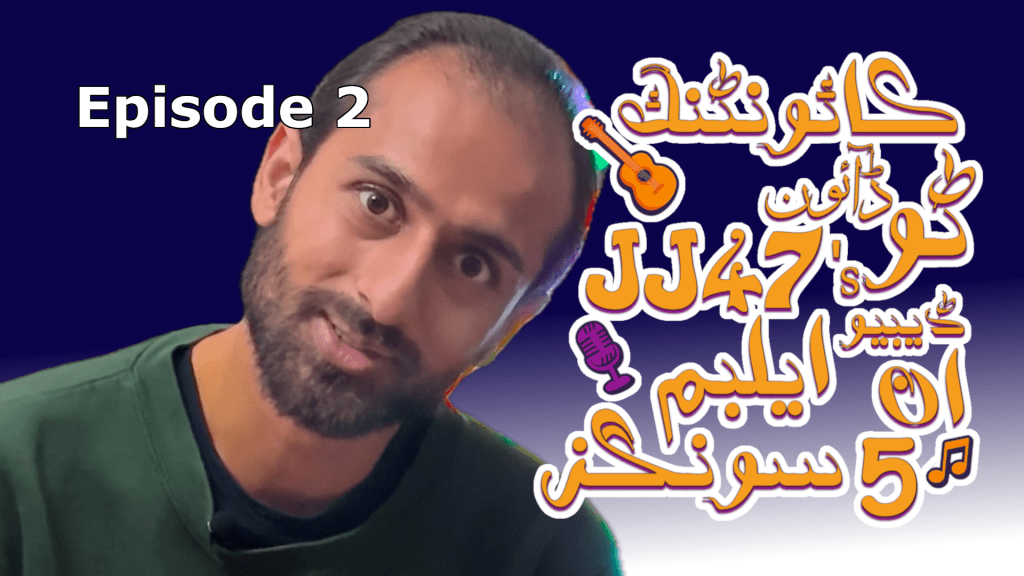
Salam-o-alaikum and welcome back to the Music Chaat BTS blog. In this episode, which I hope you have watched by now, I express my sheer delight at discovering Gulshan from Jokhay’s 2021 album, Khana Badosh. I remember distinctly the moment I switched to its “slowed and reverb” version which brings out the song’s character and infinite dopamine at a more digestible pace in addition to helping understand how Jokhay captures the motif of the Karachi sea breeze on the guitar and bass drum. It is no wonder that I have around 300 loops of the first two verses from the slowed version (0-209 seconds) on listenonrepeat.com. As a kid when I listened to music on a cassette player and its batteries would begin to die, the slowing motors would create the original “slowed and reverb” effect my mind has held on to.
Gulshan is also an ensemble rap, often the go-to formula in Urdu rap, giving us a lot to understand. In Episode 3, I will hope to admire JJ47’s solo Unwaan from his 2023 EP Talk to You Later which bucks this trend and still produces a spectacular result.
Gulshan starts with Shareh’s “all-time legendary Urdu rap verse.” After hundreds of attempts, I can only barely sing along to the first 3/4s of the verse which showcases the volume and energy he pours into it. I found this verse eye-opening also for serving as a vehicle for outwardly global musical discovery towards Skepta and Stormzy, notable UK grime rappers, when traditionally we are trained to look inwards to Pakistani music from the outside.
JJ47’s own verse starts with such a memorable line and so is the general switching of the “Iqbal Cap” between Shareh, JJ47, and Talhah Yunus as all three speak to us directly and prescribe new directions (which Jokhay sings about as well). Manzar Kashi from the same album deserves close listening as well for also telling JJ47’s story.
The process of recording this episode was also quite enjoyable. I am hoping to produce Music Chaat content regularly and this episode felt like hitting the stride given its much shorter idea-script-editing-release turnaround. I also realized while recording this episode that, for now, the main “action” I want you to take is to listen to the music that I cite in this show. I have compiled it as a Spotify Playlist and believe you will enjoy JJ47’s own work and other relevant works from both Pakistan and abroad. It also features the “meta” icons from Pakistani music that I mention as relevant to JJ47’s verse in Gulshan. In the future, I plan to reveal similar playlists homing into a specific emotion, such as umeed in the case of Jal’s “Ik Din Aye Ga” and “Har Jagah Hai Jal”, Madam Noor Jehan’s “Gaye Gi Dunya Geet Meray”, Ali Azmat’s “Gallan”*, and Asrar’s “Mast Hua” (which I erroneously refer to in the episode as “Ishq”).
This past weekend, JJ47 also performed in Toronto not far from me in Arlington, Virginia and toying with the idea of a Music Chaat JJ47 concert vlog + interview was quite appealing though, unfortunately, ultimately unfeasible.
I talk about Jokhay’s drum programming in the episode which, in terms of creative pursuit, links to Rustam Fateh Ali Khan’s 2014 Meri Dharkan where his smooth singing is complemented by the band’s music and his own excellent drum playing with the excellence lying in Rustam’s pursuit of a Western musical instrument, the drum kit, while associated with a rich lineage of classical vocalists. This album deserves tuning in from cover to cover and helped me break the myth that works like Mekaal Hasan Band’s Sampooran–a bona fide classic of Pakistani music in its own right–occupy an unsurpassed space. It is much more interesting to believe, as is true, that similar works are out there; you and I are just yet to discover them. I find Amanat Ali Khan’s two albums 2009’s Kohram and 2016’s Tera Zikr to be relevant–they too combine excellent light classical singing with expressive and memorable writing and music playing.
Thank you for reading and for watching the episode! As always, please share your thoughts with us! See you with Episode 3 soon!
*Gallan is an Ali Azmat braggadocio from 2008’s Kalashinfolk where, it sounds like he is taking aim, squarely, at music critics and talking about pioneering a new kind of life as a Pakistani rockstar:
“Asi chalay te chaliyaan haneriyaan
Asi gaj waj phatiyaan ukhariyaan
Asi kasraan chaddiyaan ne kehriyaan
Nawee life te churiyaan ne pheriyaan
Gallan reh gaiyaan ne kehriyaan?”
 Music Chaat
Leave a comment